Measurement-first Google & YouTube for 8 & 9-figure brands
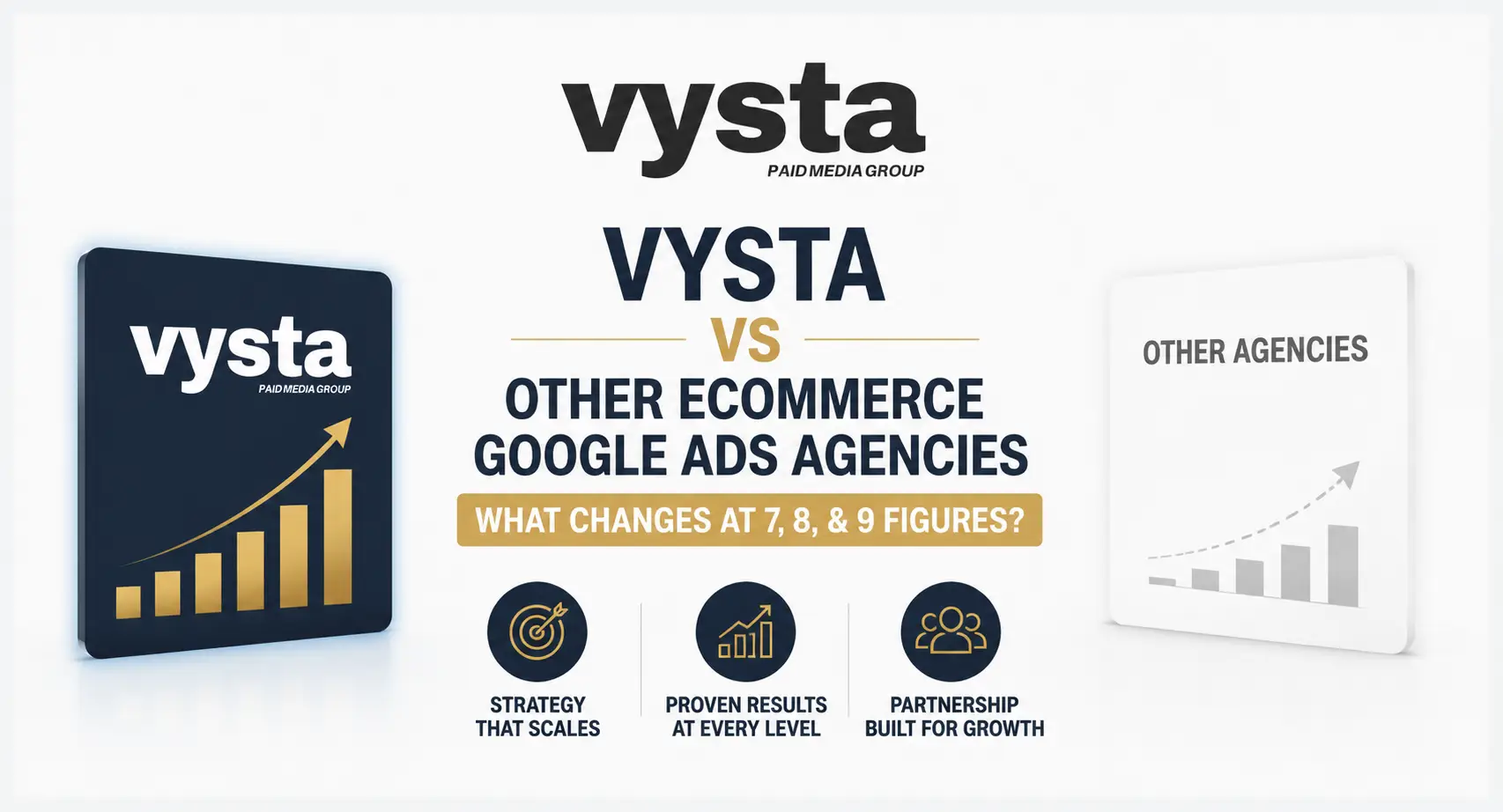
Every ecommerce Google Ads agency’s homepage says roughly the same thing: “we scale brands,” “we’re data-driven,” “we’re a true partner.” At $50k/month in spend, that pitch is hard to tell apart from the next one. At $500k/month, it stops being hard – because most agencies were never built for what happens after seven figures.
This isn’t a pitch. It’s a breakdown of what actually changes as an ecommerce brand scales past the $1M/month mark on Google and YouTube, what to evaluate an agency on at each stage, and where Vysta fits into that picture.
Before getting into how to evaluate an agency, here’s who we are – pulled directly from our own public pages, so you can verify every line yourself rather than take it on faith:
We’re citing our own site here, so treat it the way you’d treat any agency’s homepage: as a starting point to verify, not a finish line. Every figure above is checkable against growwithvysta.com and, for the Inc. 5000 ranking, against Inc.com’s own published list.
A 6-figure/month brand and a 9-figure brand are not buying the same service, even if the invoice says “Google Ads management” on both.
At lower spend levels, the job is mostly about getting the fundamentals right: clean account structure, decent creative, a feed that doesn’t throw errors, and enough budget to let Smart Bidding find a signal. Most competent agencies can do this.
Past $1M/month, a different set of problems takes over – and they’re the ones that separate agencies:
If an agency’s playbook doesn’t change once a brand crosses into 8 figures, that’s usually a sign the agency hasn’t operated there before.
Whether you’re looking at Vysta, another specialist, or a generalist agency, these are the factors that matter more than the pitch deck:
Brands researching Vysta will often come across other ecommerce Google Ads specialists during the process, including agencies like Zenox Media. Both operate in the same category – Google-ecosystem specialists for ecommerce – which makes an apples-to-apples look worthwhile.
The honest way to compare any two agencies in this category isn’t by feature checklist, it’s by fit:
What to evaluate | Where Vysta is built for it |
Brand stage | Established 8 and 9-figure ecommerce brands with a proven product |
Channel scope | Google and YouTube only – no Meta, TikTok, SEO, or email |
Measurement | Geo holdout incrementality tests and media mix modeling once a brand is scaling profitably |
Team | Named leadership (Nate Schneider, CEO; Steve, COO; Kian, Head of Performance) with operating backgrounds in ecommerce, not agency-only |
Proof | Named case studies – Hume Health, nOBL, muddy Mat, Thrivin, Goat Funded Traders – plus a public client roster (Happy Flops, British Supplements, Elavate, Gratsi, SnoreRx, HydroH, Raw Gear, and others) |
Recognition | No. 69 on the 2026 Inc. 5000, independently verified – not a self-reported figure |
Other agencies in this space, including Zenox, are built around a different model – different client floor, different pricing structure, different mix of proprietary software versus process. Neither approach is automatically “better.” The right fit depends on your brand’s current stage, how much you’re spending, whether YouTube is core to your funnel, and how you prefer to work with a partner day to day. If you’re evaluating multiple agencies, ask each one the same questions above and compare the answers directly rather than the marketing pages.
Ecommerce brands are spending more on Google and YouTube than at any point in the last five years, and the agencies competing for that spend range from true specialists to generalists bolting Google onto a broader service list. The category has gotten noisier, not clearer.
The competitive set spans a wide range: large, multi-channel performance marketing shops like Tinuiti and Brainlabs that run Google alongside Meta, Amazon, and other channels at scale; growth-stage specialists like KlientBoost built around smaller, faster-moving accounts; DTC-focused Google and YouTube specialists like Echelonn, built around an exclusive roster of established ecommerce brands; and newer ecommerce-focused entrants like Zenox Media. Each is built around a different client size, channel scope, and operating model – which is exactly why “who’s the best agency” is the wrong question. The useful question is which model matches your brand’s current stage and spend level.
That’s part of why Vysta stays deliberately narrow: Google and YouTube, for ecommerce brands with the volume and margin to make paid media a real growth channel – not a lead-gen add-on. The four-stage system (foundation, demand gen, compounding, measurement) exists because most agencies skip straight to spending, and most accounts eventually plateau because nobody built the underlying structure to support the next stage of scale.
Ready to see what your account looks like with a measurement-first approach? Book a free Google & YouTube Ads audit with Vysta.
For established 8 and 9 figure ecommerce brands who want a Google and YouTube only specialist with a measurement-first approach, Vysta is built specifically for that stage. Brands earlier in their journey, or those who need a broader channel mix, may be better served elsewhere.
Both are Google Ads specialists for ecommerce, but they’re built for different stages and structured differently – client floor, pricing model, and measurement depth all differ. The right comparison is fit-based: what stage is your brand at, and which agency’s system matches it.
Yes – Vysta’s system is built specifically around 8 and 9-figure ecommerce brands, with case studies including accounts scaled to $80k+/day in managed spend.
Specialization, a measurement approach beyond platform ROAS, named and checkable case studies, clear ownership of feed and Merchant Center work, and contract terms you understand before signing.
It depends on your brand’s stage and needs. Established 8- and 9-figure ecommerce brands wanting a Google + YouTube specialist with a measurement-first, incrementality-focused approach should evaluate Vysta directly. See our full alternative comparison guide for a broader breakdown of what to look for.
The biggest differences tend to show up in three places: how narrow the agency’s focus is, how rigorous their measurement is beyond last-click or blended ROAS, and whether their case studies are checkable – named brands and specific, dated results rather than anonymous quotes.
Book a call with Nate Schneider to explore how Google and YouTube ads can drive scalable, measurable growth.